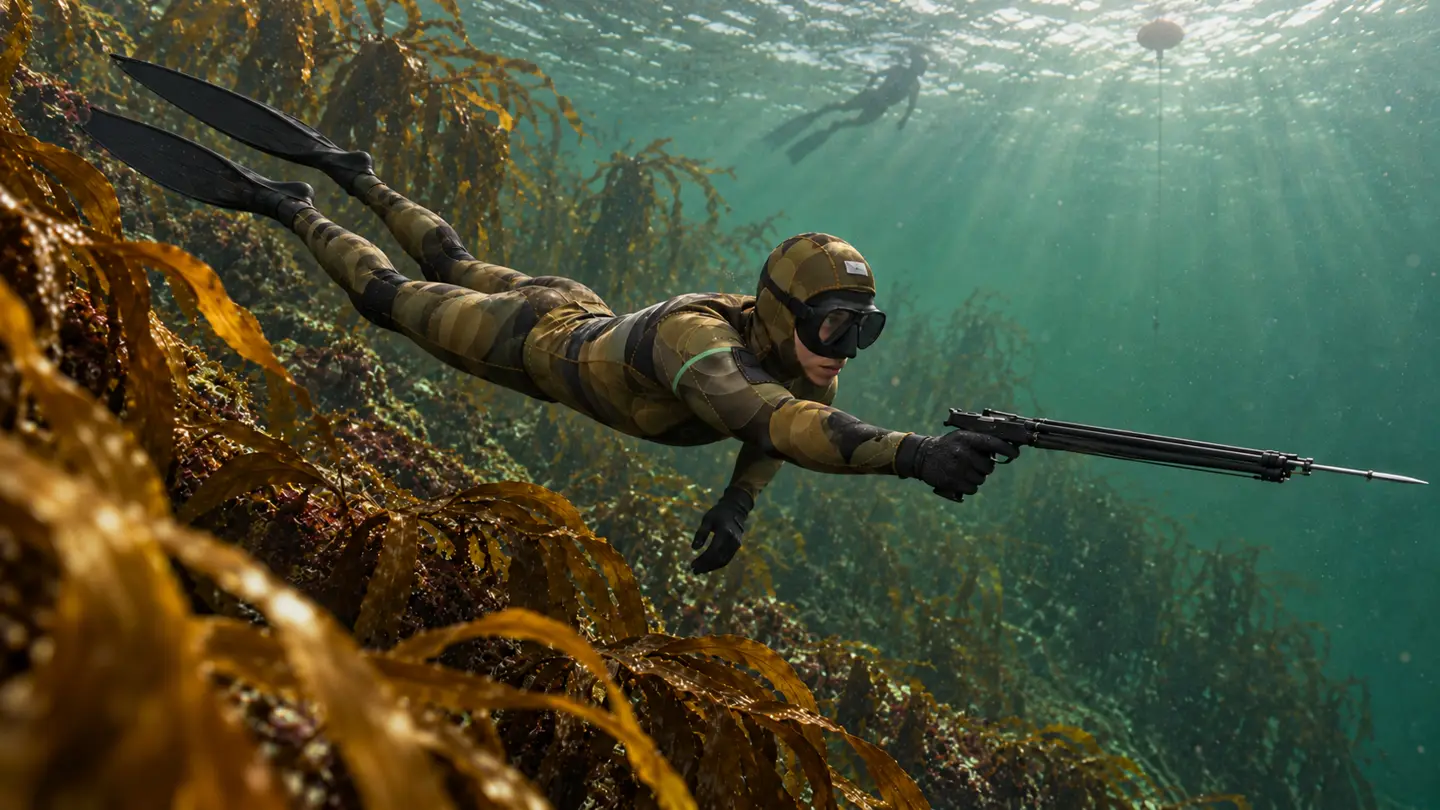
What is an open-cell wetsuit?
In freediving and spearfishing, “open cell” usually describes an unlined neoprene surface on the inside of a wetsuit. Instead of a fabric lining against your skin, the soft neoprene sits directly against it. The outside can still have a fabric covering, camouflage print and reinforced panels.
Open cell describes that inner surface; it does not tell you the suit’s thickness, the quality of its pattern or how well it will fit. Those decisions still matter. An open-cell suit that gaps at the neck or pulls across your shoulders is not automatically a better choice than a well-fitting lined suit.
Open cell versus a fabric-lined interior
| Consideration | Open-cell interior | Fabric-lined interior |
|---|---|---|
| Against the skin | Exposed neoprene; designed for close contact. | A textile layer between skin and neoprene. |
| Putting it on | Usually needs a suitable wetsuit lubricant and careful handling. | Often easier to put on without lubricant; follow the manufacturer’s instructions. |
| Handling | Take particular care with fingernails, jewellery and rough surfaces. | The lining helps protect the inner surface, but seams and seals still need care. |
| Choosing thickness | Assess the whole suit, your fit and your diving conditions. | The same checks apply; the lining alone is not a temperature rating. |
How should an open-cell freediving wetsuit fit?
Look for even contact through the torso and at the neck, wrists and ankles. You should be able to breathe comfortably, raise your arms and move into your usual swimming position. A suit should not restrict a full breath. Persistent gaps, strong pulling at the crotch or painful pressure are reasons to reassess the size or cut.
Measure against the maker’s size chart rather than relying only on your usual clothing size. A dedicated women’s cut can provide a different balance through the bust, waist, hips and torso; read our women’s freediving wetsuit fit guide for the measurements to check.
Does open cell mean a warmer suit?
A close-fitting unlined interior can help limit water movement against the skin. That does not create a universal warmth rating. Thickness, seals, fit, time in the water, activity and individual cold tolerance all affect the experience.
Compare those factors together. Our 5.5mm versus 7.5mm wetsuit guide explains the trade-offs without assigning a single temperature range to every diver.
Putting on and caring for an open-cell suit
- Follow the maker’s instructions and use a lubricant suitable for the suit and your skin when required.
- Remove jewellery and work with the pads of your fingers. Avoid pulling at exposed neoprene with your nails.
- Ease the suit into position gradually. Do not force a tight section or stretch it by a small edge.
- Rinse after use, dry out of direct sunlight and avoid prolonged folding or compression. Check the specific care instructions before using cleaners.
GEDDON’s planned open-cell construction
The GEDDON First Edition is specified with an open-cell interior in Yamamoto 39 limestone neoprene, glued and blindstitched seams, an integrated hood and reinforced knees and elbows. The proposed Prawle is 5.5mm; the proposed Start is 7.5mm.
These are development specifications. Final construction, fit and performance will be confirmed after sample testing. Explore the reflective hood crown and other GEDDON details, or compare Moor, Kelp and Night.
About this guide
Written by GEDDON to explain wetsuit terminology and the collection in development. This is general equipment information, not a temperature rating or a substitute for individual fit advice.
Reference: Waihana’s published 5.5mm wetsuit construction illustrates current manufacturer terminology. GEDDON specifications and launch plans are described separately and remain subject to sample testing.